
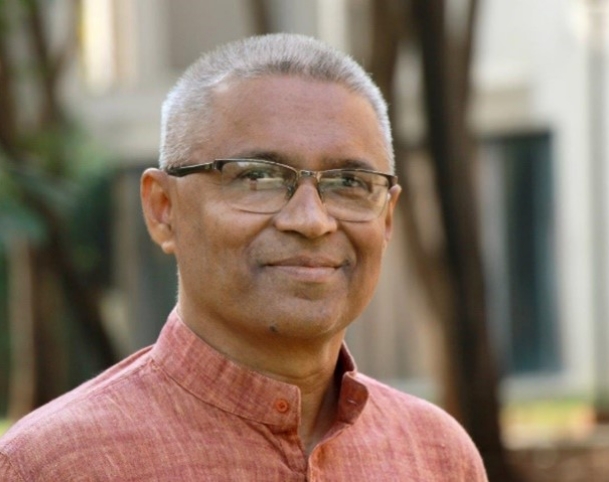
M. Des. Ph. D. (IIT Mumbai), India
Dr. Vinod Vidwans is a professor at the Department of Design, Art, and Performance at the FLAME University, Pune. Before joining FLAME University, he was a Senior Designer/ Professor at National Institute of Design (NID), Ahmedabad. He also headed the Departments of New Media Design at NID. He has been a visiting faculty & resource person at many prestigious institutes in India.
Contribution of Dr. Vinod Vidwans to Indian Music from Indian Knowledge Systems (IKS) perspective at a glance is as follows.
Reference Website: https://www.computationalmusic.com/
Dr. Vinod Vidwans is engaged in evidence-driven, demonstrable, exemplary research in Indian Knowledge Systems (IKS) focusing on Indian music augmented with advanced technology. This research reflects the aspirations of ‘New India’.
Dr. Vidwans inherits Vedic and Indic knowledge tradition and engaged in research on various Indic themes for more than last 30 years. He strongly believes in the scientific and logical ethos of Indian knowledge systems (IKS) and always feels that using advanced technology, it is possible to demonstrate the strength of IKS to the world. He also firmly believes that by adopting a scientific approach, it is possible to carry forward the legacy of ancient wisdom and provide leadership to the world in advancement of knowledge.
Dr. Vinod Vidwans is working in the domain of computational music and musicology augmented with generative Artificial Intelligence (AI) for Indian music for more than 30 years. As a result of this research, a new theory of Indian music – ‘A Generative Theory of Indian music’ has been developed. The theory addresses a wide range of outstanding issues in Indian music and provides a scientific solutions as mentioned below.
A book titled: `The Doctrine of Ragas in Indian Music’: With Nava Gana Ragas System. The Doctrine of Ragas in Indian Music
A monograph titled: `The Doctrine of Shrutis in Indian Music’. https://computationalmusic.com/research-publications/Doctrine-of-Shruti.html
The work on Indian Music and Artificial Intelligence is widely covered by the media.
Website: https://www.computationalmusic.com/
YouTube Channel: Indian AI Music
https://www.youtube.com/channel/UCm_QHdRyO9kcmDqx_OY0KnQ
Email: vinodvidwans@gmail.com, vidwans@flame.edu.in
Mobile: +91 96230 35 917
Address:
B-307, Venkatesh Riviera, Lane No. 2, Shahu Colony, behind Cummins College,
Karvenagar, Pune, India, Pin: 411052
When Dr. Vinod Vidwans started working on his research on AI and Indian Music, AI and ML were still in very nascent stages. When he started out, computational learning wasn’t a focus area yet, and depended more on automating regular tasks. Music was not at the forefront of any AI-centric initiative.
“When he started working on this project, these paradigms weren’t there at all. He had to create everything from scratch.
Dr. Vidwans extensively studied the ancient treatises on Indian music such as Naradi Shiksha, Natya Shastra of Bharata, and Sangeet Ratnakar of Sharanga Deva which provide common foundations for Hindustani as well as Carnatic music. He realized that the musical concepts mentioned in these treatises are profound and there exists a logical consistency. This insight helped him to build a logical model of Indian classical music. Based on it, he developed a theoretical frame work for generating Indian Classical Music on computers which took about more than twenty years. These efforts provide foundations for computational theory of Indian Classical Music. The theory and consequential creative expert system addresses many of the outstanding issues related to Shrutis (microtones), characterization of Ragas (Indian melodic modes), classification of Ragas, Chalan or Pakad (Catch-phrase) of Raga, Raga-rendering, Vadi-Samvadi notes of a Raga and composition of a Bandish.
He started by decoding musical shastras as mentioned above, which are the bedrock of Hindustani and Carnatic classical music.
These were highly encoded shastras, but there was a unique science behind them. The first set of results came in 25 years ago.
This scientific base piqued his curiosity. He developed a theoretical framework for generating Indian classical music through an AI.
Dr. Vidwans states that the first breakthrough came from verifying these scientific bases with Hindustani and Carnatic music theory.
He started formally documenting his efforts in 2008. He used AI to counter two sides: Raga and Tala, which combine together to form a musical composition.
Currently, flute, sitar, and sarod are used to compose the instrumental AI-generated music.
Seeing a computer generate music on its own is a special kind of thrill. Dr. Vidwans, hasn’t lost any of his excitement about the projects through 30 years.
Presently, his project makes music for around 3 minutes at most for a Raga Bandish and up to 15 minutes for a Tala composition.
 Download Download